

The First Frame
March 12, 2026
BY PETER SANDEL : PROVENANCE & PATINA JOURNAL
How a basement workbench and a Texas frame shop shaped how we present art today
Before interior design, before galleries, before Chip and Joanna made their mark on Downtown Waco, and certainly before Provenance & Patina, my first real design job was behind a custom framing counter in college.
But the story started earlier.
Many who know me would say my creativity was nurtured by my mother, and that’s true. But my father was shaping it too in his own way, teaching me patience, precision, and the kind of time and care true craftsmanship requires. My mother was a prolific cross-stitcher, and when she finished a piece, it would make its way downstairs to my father’s workbench in our basement. That’s where the transformation began.
He would lay out the mats, mouldings, and backing boards, and let me help choose mat colors and stretch the needlework over foam board. I remember watching him join the frame corners with tiny nails, adjusting and refining every detail until the piece felt right. Sometimes we were down there for hours.
At the time, it simply felt like time spent with my dad. Looking back, I realize I was learning something bigger: considered craftsmanship takes patience, and not every beautiful thing is meant to be finished in one sitting. I remember him stepping away from projects and returning later with fresh eyes. I believe that’s true for all creative work. Creating something meaningful should not be rushed.
Just before sealing the back of a finished frame with brown paper, Dad had a ritual I’ve never forgotten he would write a note on a five- or ten-dollar bill and attach it to the back of the piece. He liked the idea of someone discovering that surprise years later when they went to reframe the work. Even then, he understood a finished object could hold more than what was visible from the outside.
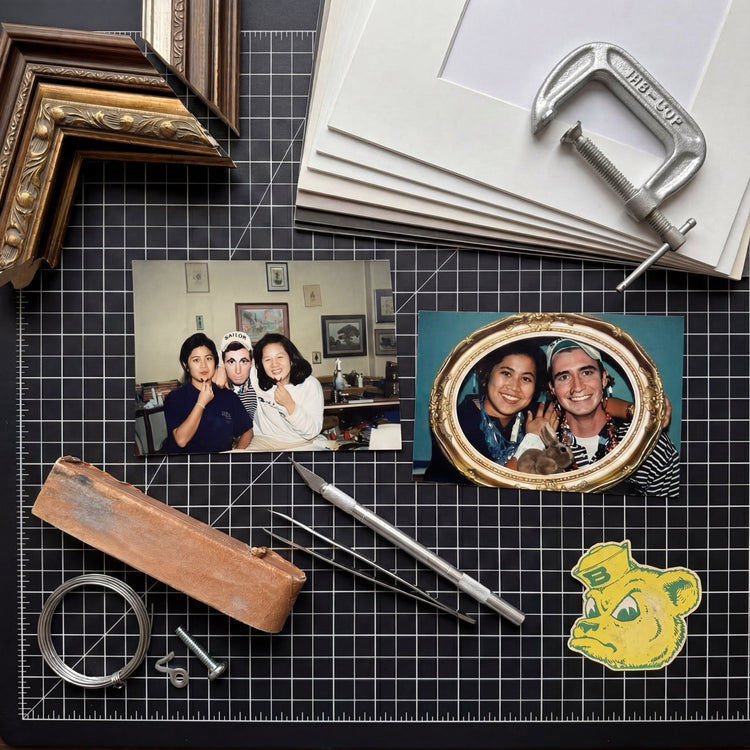
Years later at Baylor University, I found myself working at The Frame Shop + Gallery in Waco, Texas, owned by Martha Jo, who hired Baylor students and taught us the craft the best way possible: hands-on.
She let us do everything—cut glass (break glass), cut mats, cut mouldings—and yes, many of those early 90-degree cuts were not exactly 90 degrees. But she let us learn by doing, and by messing up and starting over. Her son managed the shop day to day, but Martha Jo set the tone. It was a creative, lively place, and we learned far more than we knew at the time.
Most importantly, we learned that presentation changes everything. A modest drawing could feel important with the right mat. A photograph could suddenly feel like gallery art with the right frame. And often the most important decision wasn’t aesthetic at all—it was how to protect the artwork over time.
Those lessons remain part of every frame we curate for our gallery collection.
Framing Is Architecture for Art
Framing is about more than decoration. It’s about structure, proportion, and how an artwork lives in a room.
That philosophy informed the two framing systems we use today. Our box frame is the foundation of the collection: clean, modern, and intentionally accessible. It offers subtle depth and a gallery-minded presentation at an approachable entry point.
Our spacer frame, or shadow box, creates more air around the artwork, allowing the piece to feel as if it floats within the frame. It’s a more dimensional presentation that gives works on paper added presence.
Materials Matter
Working in framing taught me that the materials behind the glazing matter just as much as the frame itself.
Each custom framed art print is produced on museum-grade archival paper using pigment-based inks for exceptional tonal stability. The result is depth, clarity, and a finish that feels more like an art object than a reproduction.
We use museum-grade acrylic glazing rather than traditional glass. It’s lighter, clearer, and safer in real homes. If a framed piece is ever bumped or falls, acrylic is far less likely to shatter and damage the artwork. And because living with art should feel easy, our framed pieces arrive fully finished and ready to hang, complete with installed hanging hardware, wall bumpers, and balanced frame construction.
Living With Art
Art doesn’t belong only in museums. It belongs in real homes, where light shifts across it in the afternoon and where it gradually gathers meaning over time. The right frame protects the work, but it also allows it to feel effortless inside a home.
That’s the balance we aim for with every piece we produce.
Provenance is the story of where something comes from. Patina is what time does to it. For me, that story began in a basement workroom, continued in a frame shop in Waco, and lives on in the work we do today.